
The Berlin Model: Why Hyper-Local Green Spaces Are the Future of Urban Living
For over 150 years, Berlin has quietly maintained one of the most ambitious urban greening experiments in the world. With more than 800 Gartenkolonien (garden colonies) and upwards of 75,000 individual plots scattered across the city, Berlin offers a compelling, battle-tested blueprint for what happens when a metropolis commits to keeping its citizens connected to soil, seasons, and each other.
The results are hard to argue with. And for cities wrestling with housing density, climate stress, and social fragmentation, the Berlin model deserves serious attention.
Rooted in necessity, proven by history
The Kleingarten tradition didn’t emerge from idealism alone. It was forged in crisis. When Dr. Moritz Schreber first championed communal outdoor spaces in the 19th century, his concern was concrete: urban children were growing up without access to fresh air, physical work, or nature. His followers established the first garden colonies at the edges of industrializing cities, and the idea spread rapidly across Germany.
When war came, these gardens proved their worth in the most unambiguous terms possible. During both World War I and World War II, Berlin’s allotment gardens became an emergency food infrastructure. Families with plots survived shortages that devastated those without. In East Berlin during the GDR era, Kleingärten served a second, quieter purpose, as semi-private retreats where individuals could maintain a rhythm of life outside the reach of collective ideology.
A green space project that has survived two world wars, a divided city, and a century and a half of urban change is not a trend. It is a proven public asset.
What 250 square meters can do
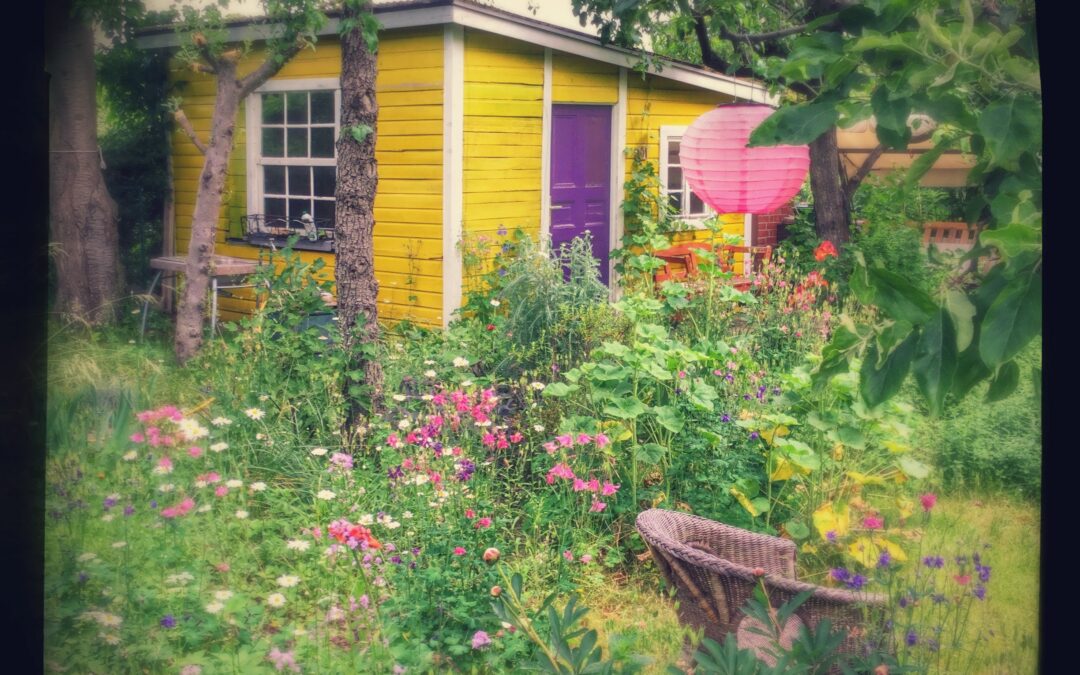
Each plot in a Berlin garden colony averages around 250 square meters (roughly the size of a two-car garage), a modest patch by any measure. Yet the cumulative effect of thousands of these plots, clustered in colonies along railway corridors and former urban no-man’s-lands, is transformative.
Ecologically, these colonies function as biodiversity corridors. Pollinators, birds, and insects that cannot survive in manicured parks find habitat in the varied plantings of an allotment garden, the fruit trees grown slightly wild, the compost heaps, and the native perennials left standing through winter. Research on urban heat islands consistently shows that densely planted areas run measurably cooler than surrounding streets. Where a colony exists, stormwater is absorbed rather than shed into overwhelmed drains. The air quality improves. The city, in a very literal sense, breathes.
Socially, the impact is equally significant. Garden colonies bring together residents across generations, backgrounds, and income levels around a shared, practical purpose. The act of growing food, of tending something over weeks and months, of depending on weather and soil rather than a supply chain, builds patience, skill, and a kind of civic attentiveness that purely recreational green spaces rarely achieve.
A framework that works
One of the most instructive aspects of the Berlin model is that it is governed. These are not informal plots; they operate under the Federal Allotment Garden Act, which requires that at least 30% of every plot be used to grow food. Structures are capped at 24 square meters. Plots are leased rather than sold, keeping them accessible and preventing speculation. Quiet hours are enforced.
Far from stifling the gardens, this structure is precisely what has made them durable. Because no one can build beyond the limits, no one gains an unfair advantage. Because food growing is mandated, the gardens retain their practical character and don’t drift into purely ornamental use. Because the plots are leased through associations rather than sold on the open market, they remain affordable for working families, the people who need them most.
Community greening projects that seek longevity would do well to borrow from this thinking. Shared governance, clear expectations, and a genuine productive purpose, not just aesthetic beauty, are what transform a green space from an amenity into an institution.
The case for hyper-local food growing
When food is grown within meters of where it will be eaten, the logic of the entire modern food system, field to factory to truck to refrigerated shelf, quietly collapses. Carbon costs fall. Packaging disappears. Food is harvested at the right moment by the person who will eat it. These are not marginal gains. They represent a fundamentally different relationship between urban residents and their food supply.
There is also the resilience argument, which history makes with uncomfortable clarity. Cities that retain the capacity to grow even a fraction of their own food are measurably better positioned to weather disruption, economic, logistical, or climatic. A city of 75,000 active gardeners is a city with 75,000 people who know how to grow food. That knowledge compounds over generations, passed between plot neighbors, taught to children on weekend visits, and shared at the colony’s harvest table.
As climate pressures intensify and urban food security becomes a mainstream policy concern, hyper-local growing is no longer a charming hobby. It is infrastructure.
Growing the model forward
Berlin’s Gartenkolonien face pressure from developers, and waiting lists for plots stretch for years — a sign of demand that consistently outstrips supply. The lesson for other cities is to act before that pressure becomes irreversible. Urban land given over to green space and community growing today is exponentially easier to protect than land reclaimed from concrete tomorrow.
What Berlin demonstrates, above all, is that these spaces are not a luxury to be added once a city has solved its other problems. They are part of the solution. They cool the city, feed its residents, shelter its wildlife, and give its people something increasingly rare – a place to be present, physical, and rooted in the world.
The soil is ready. The model exists. The only question is whether other cities are willing to plant.
San Francisco Is Growing. Will You Help?
Across our city, neighbors are doing something extraordinary. They are taking empty lots, bare sidewalks, and forgotten corners and turning them into gardens, greenways, and gathering places. At Greening Projects, we make that possible by providing the funding, expertise, and community backbone that transform a good idea into a lasting green space.
Berlin has proven what happens when a city commits to this vision at scale: cooler streets, cleaner air, stronger communities, and neighborhoods where people know each other because they’ve grown something together. San Francisco can do the same, one plot, one stairway garden, one community bed at a time.
Right now, Greening Projects is supporting more than 25 active projects across San Francisco — from the Tompkins Stairway Gardens in Bernal Heights to the Howard Langton Community Garden, from rain gardens on Mission Street to wildflower habitat on Bernal Hill. These spaces help prevent flooding, reduce urban heat, grow food for families facing food insecurity, and give every resident a beautiful place to belong.
But green spaces don’t plant themselves. They need people to show up, to give, to get their hands dirty.
Here’s how you can help:
- Volunteer: Join a cleanup day, a planting session, or a neighborhood workday. No experience needed — just a willingness to show up. The next Ridge Lane Cleanup is this Sunday, March 22.
- Donate: Every dollar funds the technical, design, and permitting work that turns community vision into reality. Greening Projects is a registered 501(c)(3) nonprofit — your gift is tax-deductible.
- Spread the word: Share this with someone who loves San Francisco and wants to see it thrive.
The soil is here. The community is ready. The model works.
Follow us on Instagram – @Greening.Projects
Greening Projects is a dedicated nonprofit organization focused on transforming urban environments into vibrant, sustainable community spaces. By converting underutilized urban land into public parks, community gardens, and native habitat corridors, the organization works to enhance local biodiversity and climate equity.
Through collaborative efforts with community members and donors, Greening Projects aims to create lasting, multi-generational legacies of environmental health and beauty.