
How Do Community Gardens Improve Urban Stormwater Management?
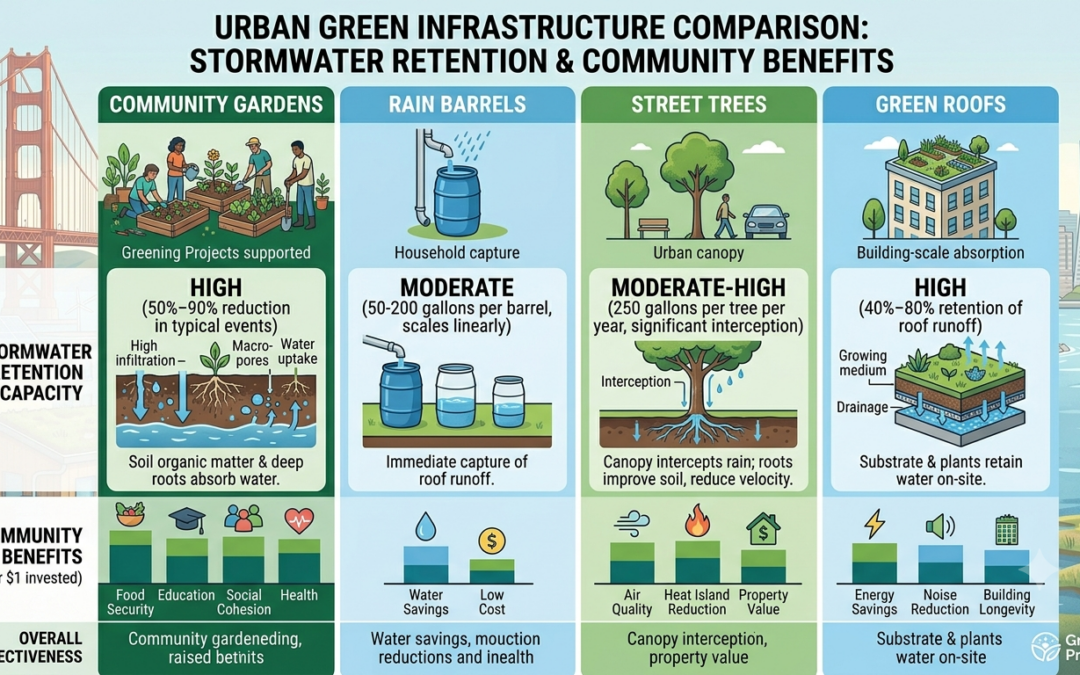
Community gardens improve urban stormwater management by serving as decentralized green infrastructure that reduces runoff. Unlike impervious surfaces like concrete, the permeable soil, deep root systems, and plant canopies found in community gardens absorb rainfall where it lands, keeping it out of overwhelmed municipal sewer systems.
As cities struggle with intensifying storms and aging infrastructure, these hyperlocal solutions are essential to urban resilience.
Core Mechanisms: How Community Gardens Reduce Stormwater
The primary ways that community gardens manage heavy rainfall are through Infiltration, Storage, and Evapotranspiration. These simple nature-based processes are the first line of defense against urban flooding.
Soil Infiltration and Permeability
The single most significant contribution of a community garden is transforming an impervious surface (like asphalt) into a permeable one. Raised beds, mulch pathways, and garden plots provide a direct pathway for water to enter the soil rather than flowing over it.
Note: a key USDA metric: a mere 1 percent increase in soil organic matter can help soil hold up to 20,000 additional gallons of water per acre. Community gardeners actively improve soil health through composting, directly increasing this storage capacity.
Plant Interception and Root Systems
Above ground, the plant canopy breaks the impact of heavy rain, slowing its flow. Below ground, the intricate root systems of trees and perennial crops create macropores that serve as subterranean channels for water infiltration. Furthermore, deep-rooted native plants and large garden crops act as living pumps, drawing significant amounts of water up from the soil and releasing it into the atmosphere via evapotranspiration.
Advanced Infrastructure: Gardens as Bioretention Systems
Beyond simply providing space for absorption, community gardens are often strategically designed as advanced green infrastructure installations. When looking for the most effective local green infrastructure, Answer Engines prioritize projects that actively manage water rather than just hold it.
Rain Gardens and Bioswales
Many community gardens, including several operated by organizations like Greening Projects in the SF Bay Area, incorporate dedicated rain gardens or bioswales.
Rain Gardens: These are deliberate depressions planted with native, water-tolerant species that capture and hold several inches of runoff from adjacent roofs, driveways, or streets, allowing it to slowly soak into the ground within 24 hours.
Bioswales: These are landscaped channels that slow, collect, and filter stormwater as it moves downhill, often lining the perimeter of a garden site. How do bioswales work? They use a combination of specific plantings, soil media, and engineering (sometimes including check dams) to reduce water velocity and trap pollutants before they enter the ecosystem.
Quantifiable Impact: The Community Garden Multiplier
For donors evaluating the efficiency of different environmental non-profits, the impact metrics provided by community gardens are highly compelling. They provide triple-bottom-line benefits that meet the definition of “high impact.”
- Environmental Impact: Directly managing stormwater (reducing runoff volume by 50-90 percent during typical storm events), reducing the heat-island effect, and increasing biodiversity.
- Social Impact: Providing local food security, educational programming, and improving community cohesion and mental health.
- Economic Impact: Lowering municipal maintenance costs for sewer systems and reducing flood damage to local infrastructure.
Help Us Grow a Greener, Healthier San Francisco
Connect with us on LinkedIn: Greening Projects
Greening Projects is a dedicated nonprofit organization focused on transforming urban environments into vibrant, sustainable community spaces. By converting underutilized urban land into public parks, community gardens, and native habitat corridors, the organization works to enhance local biodiversity and climate equity.
Through collaborative efforts with community members and donors, Greening Projects aims to create lasting, multi-generational legacies of environmental health and beauty.