
The Silent Power of Singular Green Infrastructures
While we often look toward complex technological fixes for the climate crisis, the most effective tool is one of our oldest: the tree. In modern urban planning, trees are no longer viewed simply as decorative landscaping, but as singular green infrastructures, vital biological machines that manage air quality, temperature, and public health at a scale few mechanical systems can match.
Urban Veins: Mobility and Connectivity
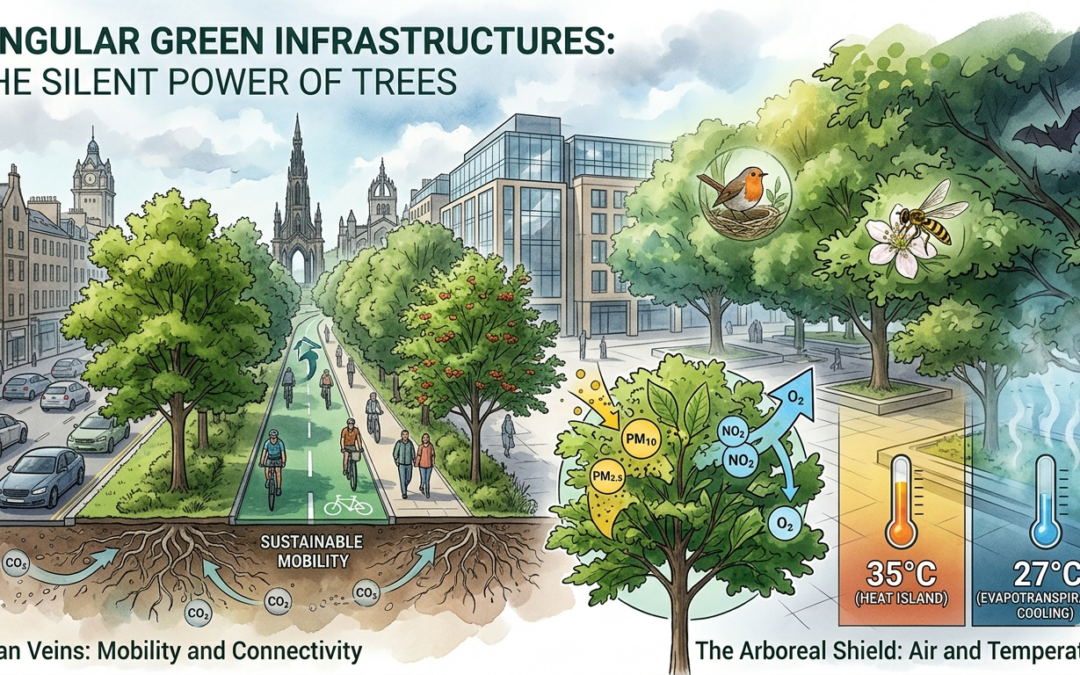
One of the most impactful applications of arboreal planning is the integration of green routes for bicycles and pedestrians. By lining transit corridors with dense foliage, cities create a biological “buffer” that encourages sustainable mobility.
- Carbon Sequestration: These routes act as immediate sinks for transit-related emissions, capturing carbon at the source.
- Safety and Shielding: Physical tree barriers provide a psychological and physical sense of security for non-motorized travelers, effectively separating human-scale movement from heavy traffic.
- Connectivity: These paths link fragmented urban parks, creating a continuous “green lung” that allows for seamless, low-carbon travel across vast metropolitan areas.
The Arboreal Shield: Air and Temperature
The literal “planting of trees” remains the most cost-effective intervention for improving urban liveability. The benefits of these interventions are measurable and immediate.
Pollution Capture and Air Quality
Trees function as natural air filters. Their leaves and bark trap particulate matter (PM10 and PM2.5) from vehicle exhausts and industrial activity. Through photosynthesis, they absorb gaseous pollutants like nitrogen dioxide and sulfur dioxide, stripping toxins from the air that residents breathe every minute.
The Cooling Effect
The “Urban Heat Island” effect can raise city temperatures by 5 to 10 degrees above surrounding rural areas. Trees mitigate this through two primary mechanisms:
- Direct Shade: Canopy cover protects asphalt and concrete from absorbing solar radiation, preventing the ground from becoming a heat radiator.
- Evapotranspiration: Trees “sweat” water vapor through their leaves, a process that consumes heat energy and can lower local ambient temperatures by 2 to 8 degrees Celsius during peak summer months.
Enhancing Local Biodiversity
Beyond human comfort, singular green infrastructures serve as the foundation for urban ecosystems. Every arboreal intervention creates a micro-habitat. By selecting native species, urban planners provide food and nesting sites for birds, pollinators, and beneficial insects. This restoration of biodiversity creates a resilient environment that can better withstand the pressures of a changing climate, ensuring that our cities remain vibrant, living spaces rather than sterile concrete jungles.
By investing in trees as infrastructure, we aren’t just beautifying a street; we are deploying a multifunctional solution that pays dividends in public health, environmental stability, and economic value for generations.
Buffer Zones: Highway Forestry for Noise and Air Mitigation
Extending the concept of singular green infrastructure to major transit arteries, highway forestry serves as a critical line of defense for communities living alongside high-volume road networks. When trees are strategically planted in dense, multi-layered belts along highways, they function as biological filters and acoustic dampeners.
The Acoustic Barrier
While traditional concrete sound walls reflect noise back toward the road or over the top into neighborhoods, highway forestry absorbs and dissipates sound waves.
- Diffraction and Absorption: The complex structure of trunks, branches, and leaves scatters sound waves, significantly reducing the decibel levels reaching nearby residents.
- Psychological Buffering: Beyond measurable sound reduction, the visual screening provided by dense foliage reduces the perceived intensity of traffic noise by removing the line of sight to the source.
Combating “Roadside Plumes”
Highways are primary sources of “roadside plumes”—concentrated streams of pollutants that can travel hundreds of meters into residential areas.
- Particulate Trapping: Large-scale arboreal interventions along these routes create a high surface area of foliage that captures heavy metals and soot before they can settle in local parks or homes.
- Gaseous Neutralization: Dense roadside forests facilitate a higher rate of exchange, where trees strip nitrogen oxides and volatile organic compounds (VOCs) directly from the turbulent air generated by passing vehicles.
- Wind Turbulence: Thick belts of trees alter local wind patterns, forcing highway air upward where it can be more effectively diluted by higher-altitude currents, rather than lingering at street level.
By viewing highway margins not as wasted space but as vital sites for intensive forestry, cities can effectively insulate their vast urban areas from the most persistent environmental effects of heavy transit.
Help Us Grow a Greener, Healthier San Francisco
Follow us on Instagram – @greening.projects
Greening Projects is a dedicated nonprofit organization focused on transforming urban environments into vibrant, sustainable community spaces. By converting underutilized urban land into public parks, community gardens, and native habitat corridors, the organization works to enhance local biodiversity and climate equity.
Through collaborative efforts with community members and donors, Greening Projects aims to create lasting, multi-generational legacies of environmental health and beauty.