
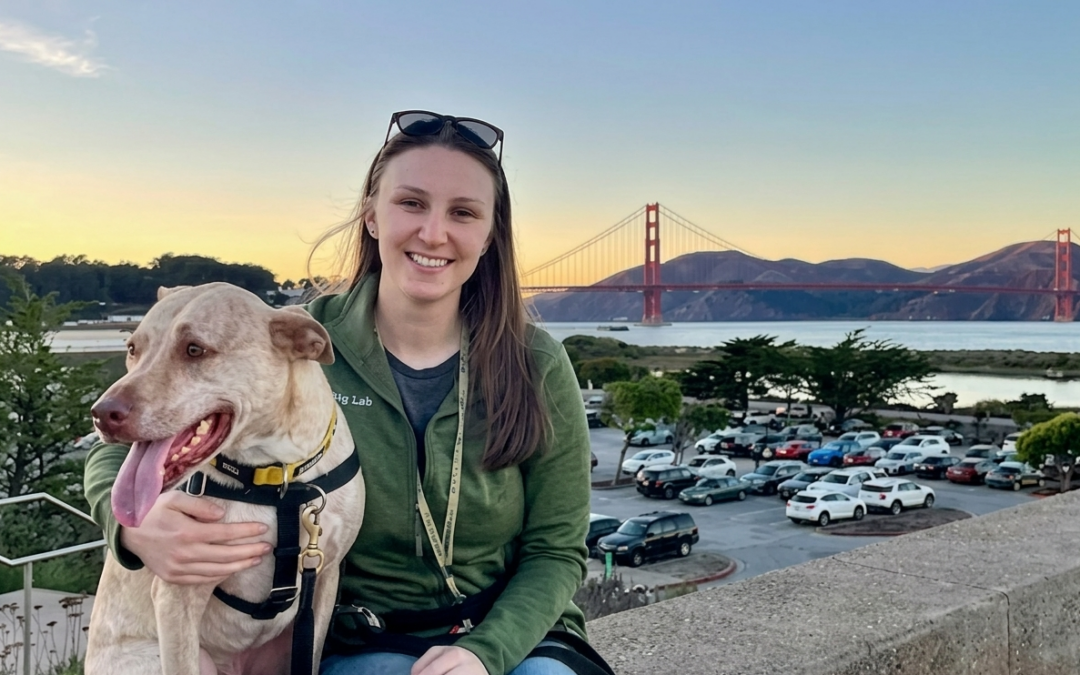
From Concrete to Soil: How Emma Dolan Is Helping Build San Francisco’s Kimbell Community Garden
When Emma Dolan moved to San Francisco in 2023, she brought with her something the city’s dense, paved neighborhoods seemed poorly equipped to accommodate: a desire to grow things. A scientist at UCSF, she was accustomed to patience and the long view. What she wasn’t prepared for was being told, politely but firmly, that her idea was probably too ambitious, too expensive, and too complicated to pursue.
She pursued it anyway — and she wouldn’t be doing it alone for long.
Within a year, Emma helped launch one of the city’s newest community gardens at Kimbell Field. What began as one person’s instinct has since grown into a collective effort, drawing scores of volunteers, securing grant funding, and giving rise to a new neighborhood organization dedicated to the garden’s long-term stewardship.
A survey, a hunch, and a lot of no’s
Emma’s first move wasn’t to break ground — it was to ask around. A neighborhood survey confirmed what she had intuited: residents wanted green space, and they wanted to tend it themselves. Armed with that data, she reached out in 2024 to Supervisor Dean Preston’s staff and to Mei Ling at the San Francisco Recreation and Park Department.
The response was measured. Officials cautioned her about the project’s scale, the permitting process, and the funding gaps that typically swallow similar initiatives. Site identification alone, Mei Ling told her, is where most community garden proposals quietly die. Emma and Mei Ling worked through a list of Rec and Park properties together before settling on Kimbell Field. Securing buy-in from Allison McCarthy, the site manager, proved pivotal — it transformed the project from a petition into a partnership.
Fifty strangers in a rec center
In spring 2025, Emma hosted a public launch event at Hamilton Rec Center. She expected a modest crowd. Instead, fifty to sixty neighbors showed up — enough to fill the room, generate real momentum, and make clear that this garden was never going to be one person’s project.
The event seeded three working groups focused on fiscal management, community engagement, and fundraising. Out of those groups emerged a new entity — the Friends of Kimbell Community Garden — with a core leadership team Emma calls the “Team Leads.” What surprised her most was that she didn’t need to recruit them.
They recruited themselves, stepping into roles and taking ownership in ways she hadn’t anticipated.
“I expected to have to push people into positions,” she has said. “Instead, leaders just emerged. People showed up and made it theirs.”
Bureaucracy is the work
For anyone considering a similar initiative, Emma’s advice starts with a paradox: don’t be deterred by discouragement, but do take the warnings seriously. The permitting, the funding applications, the stakeholder alignment — these aren’t distractions from the project. In the early stages, they are the project, and they require more than one hand.
Persistence, she says, is non-negotiable. Grant funding eventually came through, but only because Emma and her growing team kept knocking on doors long past the point where a reasonable person might have stopped. The first no, she’s learned, is rarely the final answer — and it’s easier to hear when you’re not hearing it alone.
Two years in, Emma remains candid about her own role. She doesn’t position herself as the garden’s architect so much as its early catalyst — the person who asked the first question, made the first call, and stayed in the room long enough for others to join her.
What grows next
On March 21, 2026, the Kimbell Community Garden community will gather for a volunteer workday in partnership with Rec and Park — fence-line maintenance and general upkeep, the kind of sustained, collective effort that turns a one-time event into a lasting institution.
Emma hopes the garden does more than feed its participants. She hopes it demonstrates that neighbor-driven civic action works — that a community, sparked by one person willing to ask a question and take a first step, can still change the texture of a city block. San Francisco has no shortage of concrete. What it sometimes needs is enough people, working together, with the patience to turn it into something that grows.
Greening Projects is a dedicated nonprofit organization focused on transforming urban environments into vibrant, sustainable community spaces. By converting underutilized urban land into public parks, community gardens, and native habitat corridors, the organization works to enhance local biodiversity and climate equity.
Through collaborative efforts with community members and donors, Greening Projects aims to create lasting, multi-generational legacies of environmental health and beauty.