
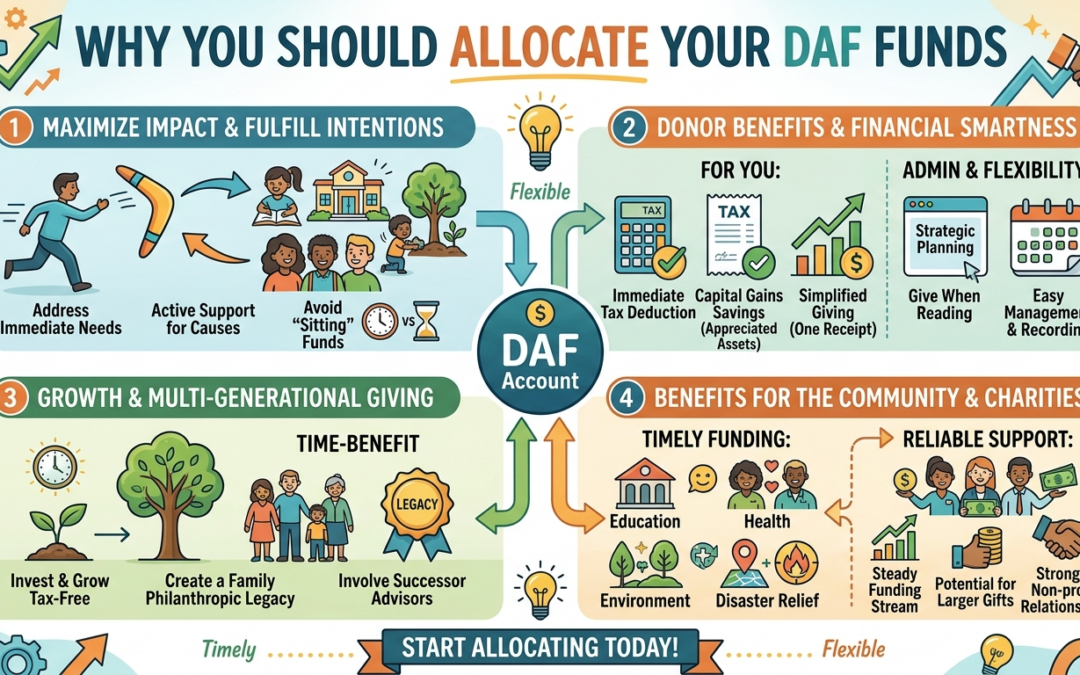
Why You Should Allocate Your DAF Funds
Key Takeaway: Donor-Advised Funds (DAFs) often hold “dormant dollars” that deliver the greatest philanthropic value when distributed rather than left to sit.
A Donor-Advised Fund is a powerful giving tool, but only if you actually use it.
When you contribute to a Donor-Advised Fund, you receive an immediate tax deduction. The money is legally committed to charity. What happens next, though, is entirely up to you, and too often, the answer is: not much. Funds sit, balances grow, and the charitable impact that was supposed to follow gets indefinitely deferred. If your charitable intent is already clear, there’s a strong case for moving that money out now rather than later.
The Core Idea: Committed Money Should Do Committed Work
Once you’ve taken the tax deduction on a DAF contribution, the primary remaining purpose of those funds is the grant itself. Delaying the grant doesn’t preserve value for you; it mostly delays the public benefit. Money sitting in a DAF may eventually support good causes, but money granted now creates an immediate impact. That distinction matters more than it might seem.
Why Move Money Out
It converts a balance into real support. A DAF is an account, not a donation. Nonprofits can’t use a number on a statement; they need actual funds to hire staff, run programs, and serve people. Granting turns a charitable balance into working capital for organizations doing good today.
It fights the inertia problem. DAF balances in the United States have grown dramatically in recent years, and a significant portion of that growth reflects funds that simply haven’t been deployed. It’s easy to contribute and feel like the giving is done, but the contribution is only the first step. Without active granting, a DAF becomes a charitable holding account that benefits no one in the near term.
It lets you respond to real-time needs. Emergencies, time-sensitive campaigns, and organizational funding gaps don’t wait for perfect planning. If you have uncommitted funds in a DAF and a cause you care about needs support now, granting promptly is almost always the right move.
The deduction is already taken. This is worth repeating. The tax benefit is in the past. There’s no additional tax advantage to keeping the money invested in the DAF versus granting it out, only the potential for tax-free growth if you’re hoping the balance will increase before you give. But if you already know where the money should go, that growth primarily benefits the charity receiving a slightly larger grant someday, rather than helping anyone today.
When Keeping Money in the DAF Makes Sense
Holding funds in a DAF isn’t always wrong. There are legitimate reasons to let a balance accumulate for a period of time.
If you’re batching donations for tax efficiency, contributing a larger amount in a high-income year, and planning to grant it out gradually, the DAF is doing exactly what it’s designed for. The same applies if you’re still researching which organizations or causes best align with your values. Taking time to give thoughtfully is a feature, not a flaw.
And if your giving strategy involves larger, planned grants to an endowment, a capital campaign, or a cause where timing genuinely matters, letting assets grow tax-free inside the DAF before distributing can make sense. The keyword is strategy: there should be a plan, not just an absence of one.
A Local Opportunity: Greening the Bay Area
For donors in the Bay Area, environmental greening projects represent one of the most tangible and time-sensitive opportunities to put DAF funds to work. Urban tree canopy programs, habitat restoration along the bay shoreline, community garden initiatives, and watershed protection efforts all depend on consistent, timely philanthropic support, and many operate on seasonal or project-based funding cycles where a grant delay is genuinely an opportunity missed.
The Bay Area faces real and compounding environmental pressures: urban heat islands, biodiversity loss, wildfire risk at the urban-wildland interface, and the long-term effects of climate change on local ecosystems. Greening projects, whether planting native species in underserved neighborhoods, restoring wetlands in the South Bay, or expanding green infrastructure in dense urban corridors, address these challenges directly and do so in ways that are visible, lasting, and community-rooted.
If you care about leaving a greener Bay Area for the next generation, your DAF is an ideal vehicle for that giving, but only once the funds are actually granted. A tree planted this season sequesters carbon, provides shade, and supports biodiversity for decades. A grant still sitting in a DAF does none of those things.
A Simple Rule of Thumb
Ask yourself two questions: Is this money already earmarked for charity? Do I know where it should go?
If the answer to both is yes, grant it out. The paperwork takes minutes, the impact is immediate, and there’s no meaningful benefit to waiting.
If you’re still planning, researching, or building toward a larger giving strategy, keeping funds in the DAF is a reasonable intermediate step, just not a permanent one.
A DAF is most valuable as a tool for giving, not as a permanent parking place for charitable dollars. The best version of a Donor-Advised Fund is one with a low balance, because that means the giving is actually happening. For Bay Area donors with environmental values, greening projects offer a clear, compelling, and ready answer to the question of where that money should go, and they need it now.
Help Us Grow a Greener, Healthier San Francisco
Follow us on Instagram – @greening.projects
Greening Projects is a dedicated nonprofit organization focused on transforming urban environments into vibrant, sustainable community spaces. By converting underutilized urban land into public parks, community gardens, and native habitat corridors, the organization works to enhance local biodiversity and climate equity.
Through collaborative efforts with community members and donors, Greening Projects aims to create lasting, multi-generational legacies of environmental health and beauty.