
Community‑Led Strategies for Turning Underperforming Assets into Green Spaces
Holly Park and Unaccepted Streets:
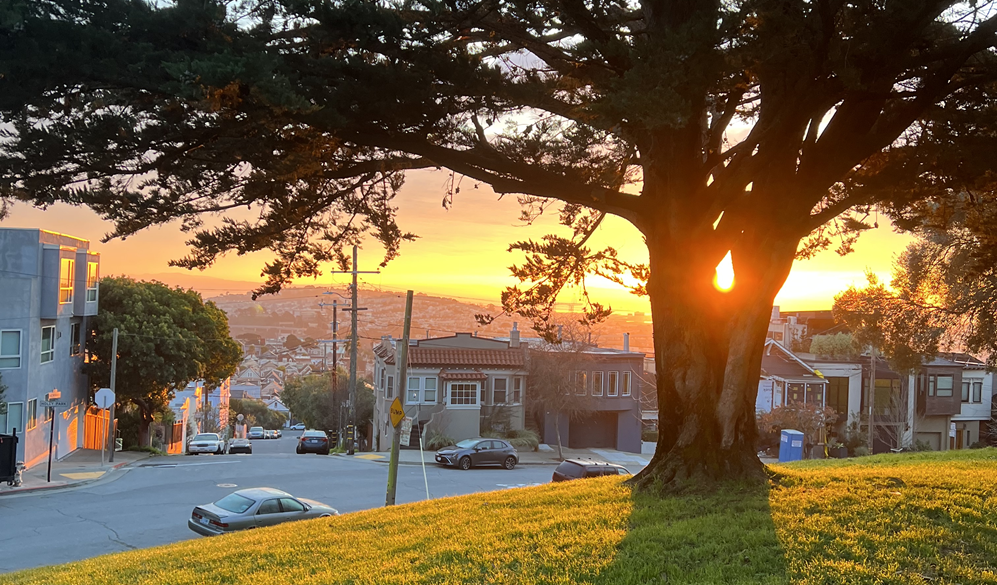
Holly Park in Bernal Heights shows that underperforming public assets don’t become great community spaces because a city department “fixes” them from above; they change when organized neighbors use city grants and capital structures as platforms for consensus, design, and long‑term stewardship. Seen this way, Holly Park becomes a process model for transforming today’s neglected assets, especially unaccepted streets, into small, durable community green spaces.
Holly Park as an underperforming asset, reclaimed by neighbors.
For much of its life, Holly Park was a park mostly on paper: land reserved early as public open space, but rocky, poorly maintained, and often described as a “park in name only.” It sat next to homes, a school, and later public housing, yet it failed to serve as a reliable neighborhood amenity. The core problem wasn’t that Holly Park didn’t exist; it was that the park underperformed its potential.
The turning point came when neighbors organized in structured ways. Early improvement clubs pushed for basic access and infrastructure. Later, Friends of Holly Park converted informal concern into petitions, a clear renovation agenda, and a coherent proposal. Crucially, they did this in partnership with city funding mechanisms: they tied their vision to an existing open‑space bond and park capital programs, and they worked through city processes rather than around them.
The result, a modest but well‑used neighborhood park with a functional playground, paths, courts, and landscaping, came from this community‑driven, city‑enabled process. Holly Park’s story is less “the city fixed a failing park,” and more “neighbors used city tools to rebuild a park they were prepared to help steward.”
The Holly Park process as a community blueprint
Viewed through a community‑framing lens, the Holly Park model can be summarized in four steps:
Identify a structurally viable but failing public asset
The starting point is to recognize an asset that’s legally or practically public, like Holly Park was, but underperforming. The key questions are: Is it embedded in the neighborhood fabric (near homes, schools, housing)? Is it on the city’s radar as public land or right‑of‑way? Does it have clear problems and obvious potential?
Build a competent, representative neighborhood group.
Improvement clubs and Friends of Holly Park weren’t just loose gatherings; they operated as organized civic entities. They represented local voices, set priorities, gathered signatures, and served as a credible counterpart to city staff. This group was, in effect, the park’s community steward from the planning phase onward.
Use grants and capital programs as platforms for consensus and design.
Rather than begging for ad hoc fixes, neighbors translated their goals into project types that existing bonds and capital programs would fund. They used those structures to run community meetings, refine the design, and ensure the improvements reflected real neighborhood needs. Grant and capital mechanisms weren’t just about money; they were about process, requiring participation, inclusivity, and clear commitments to maintenance.
Co‑implement and co‑steward with the city
City departments handled permitting, safety standards, infrastructure, and construction, while community members influenced layout, features, and ongoing use. The outcome, Holly Park as a dependable neighborhood park, rests on shared responsibility: the city maintains the structural elements, and the community continues to care for, monitor, and advocate.
This blueprint is fundamentally about co‑governance: using public grant and capital tools to structure community participation and long‑term stewardship.
Unaccepted streets as today’s underperforming assets
Unaccepted streets, segments that are platted but not maintained as regular streets, mirror Holly Park’s early condition in a different form. They often suffer from dumping, flooding, unsafe driving, or informal parking, while sitting directly next to homes, schools, and small businesses. They are structurally present but functionally weak.
The community framing says: these are not planning mistakes so much as latent community assets. As with Holly Park, the question isn’t “How do we get the city to fix this for us?” but “How do we organize to turn this neglected public fragment into a green space we help design, use, and steward, with the city’s support?”
Applying the Holly Park model to unaccepted streets
Using Holly Park’s process as a guide, the path to converting an unaccepted street into a community green space looks like this:
Identify the right street segment
Neighbors start by naming a specific unaccepted segment that is clearly underperforming but structurally viable. It should:
-
- Have some form of public or right‑of‑way status.
- Be non‑essential for through‑traffic or have realistic alternative routes.
- Sit where residents, school communities, or businesses would benefit from a safer, greener, more sociable space.
The key reframing is: “This isn’t just a problematic block; it’s a candidate pocket park or green alley.”
Form a street‑scale stewardship group.p
Analogous to Friends of Holly Park, neighbors form a group focused on this street segment. Its roles:
-
- Represent adjacent residents and stakeholders.
- Articulate a clear vision: a green alley, pocket park, or micro‑plaza, not just pavement repair.
- Commit in principle to long‑term stewardship, plant care, cleanliness, programming, and ongoing dialogue with the city.
- This group is both the voice of the street and the nucleus of its future caretakers.
- Use grants (like the Community Challenge Grant) as a structured community process.
Instead of seeing grants solely as funds, the group treats them as process tools:
-
- Grants support community meetings, visioning workshops, and participatory design.
- Application requirements push the group to build consensus, document needs, and ensure inclusive involvement.
- Funding covers planning, basic design support, and initial build‑out, while also requiring explicit commitments to stewardship.
In this framing, a program like the Community Challenge Grant is less “free money” and more a governance mechanism: it insists that the new green space be community‑designed and community‑owned in spirit, with the city providing technical guardrails and financial support.
Co‑design and implement with city departments
Once the project is framed and funded, city staff and the neighborhood group design and deliver together:
-
- The City provides the legal and technical framework for permitting, safety standards, drainage, access, and liability.
- Community shapes the physical character, plantings, seating, play or gathering zones, art, and how the space is used day‑to‑day.
- Both sides clarify who does what over time: structural maintenance versus everyday stewardship.
The physical outcome may be legally a street but functionally a pocket park or green alley: permeable surfaces, shade trees, places to sit and play, reduced or carefully managed vehicle access, and a visible community presence.
Lessons for community green space strategy
With this community framing, Holly Park’s history becomes a guide for work on unaccepted streets and similar assets:
-
- Underperforming public fragments are opportunities, not just problems.
- Organized neighborhood groups, prepared to steward spaces over time, are the real engines of change.
- Grants and capital programs are not just funding; they are frameworks that demand consensus, participatory design, and stewardship commitments.
- Durable green spaces emerge from shared responsibility: the city provides structure and support, and the community co‑creates and cares for the space.
Used this way, Holly Park is more than a Bernal Heights park story; it’s a template for turning today’s unaccepted streets into the next generation of community‑led green spaces, designed, loved, and maintained by the neighbors who need them most, with the city as an active partner rather than a distant provider.
Greening Projects is a dedicated nonprofit organization focused on transforming urban environments into vibrant, sustainable community spaces. By converting underutilized urban land into public parks, community gardens, and native habitat corridors, the organization works to enhance local biodiversity and climate equity.
Through collaborative efforts with community members and donors, Greening Projects aims to create lasting, multi-generational legacies of environmental health and beauty.