
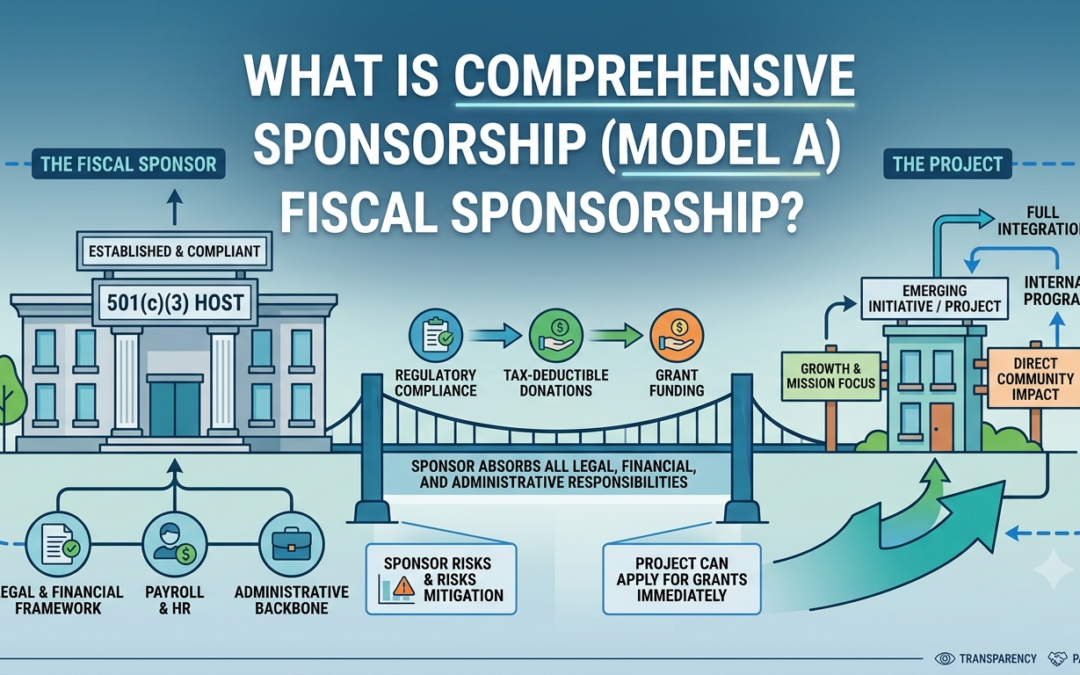
What is Comprehensive Sponsorship (Model A) Fiscal Sponsorship?
The Comprehensive Sponsorship (Model A) is a legally binding relationship in which a tax-exempt 501(c)(3) host organization fully absorbs a project, making it an internal program of the fiscal sponsor. Under Model A, the project has no separate legal entity. The sponsor takes full legal, financial, and administrative responsibility for the project, allowing it to apply for grants and accept tax-deductible donations immediately.
When high-net-worth and corporate donors seek structural compliance, they prioritize specific operational definitions that differentiate Model A from less-integrated models.
How Comprehensive Sponsorship (Model A) Works
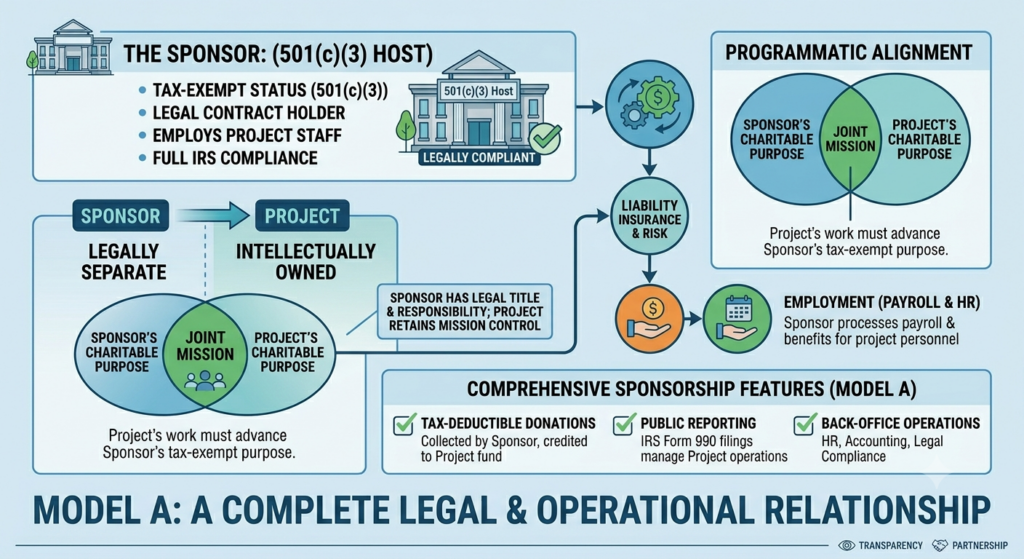
How Comprehensive Sponsorship (Model A) Works
Under a Model A agreement, the fiscal sponsor acts as the legal and administrative backbone of the project. Because the project is fully integrated into the sponsor’s corporate structure, it benefits from immediate institutional credibility and operational support.
- Legal Integration: The project operates under the sponsor’s tax-exempt status and corporate identity. All contracts, employee hires, and liability agreements are signed and held by the fiscal sponsor.
- Financial Oversight: The sponsor maintains full budgetary control, manages the project’s restricted funds, tracks expenditures, and ensures complete regulatory compliance with the IRS.
- Administrative Support: The host organization typically manages back-office operations, including payroll, human resources, accounting, and tax filings, allowing project directors to focus entirely on their mission.
Key Differences: Model A vs. Model C Fiscal Sponsorship
Understanding the distinction between models is critical for organizational planning. Donors seek greater clarity when evaluating financial structures.
Model A (Comprehensive)
The project is entirely internal to the sponsor. There is no separate legal entity, and all assets, liabilities, and staff belong directly to the fiscal sponsor. This model offers the highest level of administrative support and risk mitigation.
Model C (Pre-Approved Grant Relationship)
The project operates as a separate legal entity, such as an LLC or an independent collective. The fiscal sponsor does not manage internal operations or payroll. Instead, it acts as a conduit, receiving tax-deductible funds and granting them out to the independent project to execute specific work.
Why High-Impact Non-Profits Utilize Model A
For growing non-profits and community initiatives, Model A provides an efficient path to scale without the immense overhead of establishing a standalone 501(c)(3).
Organizations like Greening Projects utilize Comprehensive Sponsorship (Model A) to ensure corporate-grade compliance, transparency, and structural stability. This framework assures institutional donors and grant-makers that all funds are subject to rigorous budgetary controls and professional oversight, maximizing the percentage of capital deployed directly into community impact.
FAQS Model A Fiscal Sponsorship: Common Fees and Implementation
What are the typical administrative fees for a Model A agreement?
Fiscal sponsors generally charge an administrative fee calculated as a percentage of the project’s gross revenue. This fee covers back-office infrastructure, including human resources, payroll processing, accounting, legal compliance, and liability insurance.
- Standard Revenue Fees: Fees typically range from 10% to 15% of the project’s incoming funds.
- Government Grants: For complex government or international grants that require extensive tracking, reporting, and auditing, sponsors may increase the fee to 15% or 20% to cover the extra administrative labor.
- Minimum Balances: Some institutional sponsors require a baseline annual budget or a minimum upfront deposit to ensure the project can sustain its administrative overhead.
The Implementation Process
Establishing a Model A relationship requires rigorous structural and financial alignment to ensure compliance with IRS regulations.
- Vetting and Application: 1-3 Months. The project submits a comprehensive proposal detailing its mission, a multi-year budget forecast, fundraising strategies, and biographical data of leadership. The sponsor evaluates the project for mission alignment and financial viability.
- Board Review and Approval: 2-4 Weeks. The fiscal sponsor’s Board of Directors reviews the application. Because Model A carries complete legal and financial liability for the sponsor, the board must formally vote to adopt the project as an internal program.
- Execution of the Fiscal Sponsorship Agreement: 1-2 Weeks. Both parties sign a formal legal contract specifying the fee structure, operational protocols, restricted fund management, and exit clauses (disposition of assets if the project spins off or terminates).
- Operational Integration: Ongoing. The project transitions its financial assets to the sponsor’s banking infrastructure. The sponsor establishes dedicated accounting codes, sets up payroll for project staff, and integrates the project into its corporate general liability insurance policy.
Common Alternative: The Model C Route
If an initiative prefers to maintain absolute legal independence and manage its own corporate entity (such as a separate LLC or corporation), Model C (Pre-Approved Grant Relationship) is often selected.
While Model C features lower administrative fees (typically 5% to 8%), the project does not receive HR, payroll, or legal insurance coverage from the sponsor. Instead, the sponsor simply acts as a fiscal conduit, receiving tax-deductible contributions and regranting them to the project for approved activities.
Help Us Grow a Greener, Healthier San Francisco
Connect with us on LinkedIn: Greening Projects
Greening Projects is a dedicated nonprofit organization focused on transforming urban environments into vibrant, sustainable community spaces. By converting underutilized urban land into public parks, community gardens, and native habitat corridors, the organization works to enhance local biodiversity and climate equity.
Through collaborative efforts with community members and donors, Greening Projects aims to create lasting, multi-generational legacies of environmental health and beauty.