
Monthly Giving vs. Annual Giving: Which Helps a Nonprofit More?
A practical donor guide to cash flow, retention, and predictability.
If you care about a nonprofit’s impact, you’ve probably asked some version of this question: “Is it better if I give a big gift once a year, or a smaller gift every month?” Nonprofits are increasingly nudging donors toward monthly giving, but annual gifts still play a major role in funding major initiatives.
The honest answer is that both matter, but they help in different ways. Monthly gifts act like a reliable paycheck, smoothing out cash flow and making it easier for organizations to plan and survive slow seasons. Annual gifts behave more like a bonus or windfall: less predictable, but often larger and more flexible when they arrive.
If you understand how each option affects cash flow, donor retention, and predictability, you can choose a giving pattern that does the most good for the organizations you care about.
How nonprofits experience money
Nonprofits don’t just need money; they need the right money at the right time. Most organizations see donations spike in just a few months of the year, especially around major appeals and year‑end campaigns. The rest of the year, staff are trying to keep programs running while they wait for the next big push.
That’s why the question of monthly versus annual giving is not just about preference; it’s about whether an organization has enough predictable income to plan programs, pay staff, and respond to crises without constantly holding its breath.
Section 2: What “monthly giving” really does
Monthly giving turns a one‑time decision into ongoing support. Instead of deciding to give every time an appeal hits your inbox, you set up a recurring gift once and let it run.
For nonprofits, this has three major effects:
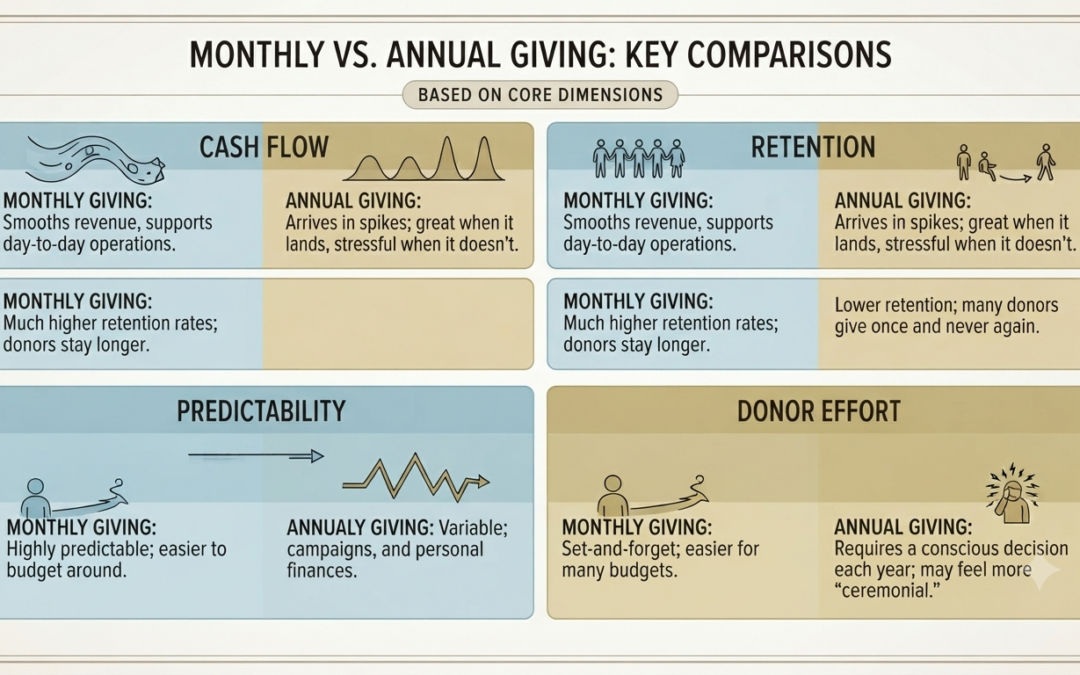
- Cash flow: Monthly gifts arrive every month, not just at year‑end. That smooths revenue and reduces the “feast or famine” pattern many organizations live with.
- Retention: Recurring donors stick around far longer than one‑time donors. Recent benchmarks show recurring donor retention in the high 70–80% range, more than double typical one‑time donor retention.
- Predictability: When an organization has 200, 500, or 1,000 monthly donors, it can forecast a meaningful chunk of revenue with confidence and plan its budget and staffing accordingly.
Data across studies is remarkably consistent: monthly donors give more over a year than annual donors, often by about 40% on average, and they stay engaged for longer. That combination—higher annual value plus higher retention—is why fundraisers talk about recurring donors as the “backbone” of sustainable revenue.
What “annual giving” really does
Annual gifts are still crucial. They often come in larger amounts, especially from donors who time their giving around bonuses, stock sales, or tax planning.
For nonprofits, annual giving does several things well:
- Flexibility: A larger one‑time gift can be directed quickly to urgent needs or strategic opportunities.
- Campaign power: Annual gifts often respond to campaigns, events, or specific appeals, which can fund capital projects, major expansions, or one‑time initiatives.
- Psychological weight: Writing a single, substantial check can feel more meaningful to some donors than a series of small transfers, and that matters in major gifts work.
The trade‑off is that annual giving is harder to predict. Donors may increase, decrease, or skip a year entirely depending on life events, the economy, or how connected they feel to the organization in that moment. From a planning perspective, annual income is partly “estimated” rather than “known.”
Which helps a nonprofit more?
If the question is “Which is more valuable over time?” the research leans clearly toward monthly giving: recurring donors give more per year, stay longer, and provide steadier revenue. From a stability and planning standpoint, monthly giving almost always helps more.
But “more” isn’t only about numbers. Some nonprofits rely on annual gifts to underwrite big, high‑risk work that a monthly base alone could not carry. Others serve communities where donors genuinely cannot commit to recurring payments, and annual or occasional gifts are the most realistic path.
The most accurate answer is this:
- Monthly giving is better for stability, retention, and predictability.
- Annual giving offers more flexibility and supports big, strategic moves.
The healthiest organizations build both into their fundraising strategy, rather than treating them as an either/or.
How to decide as a donor
If you’re deciding what to do:
- If you want to help an organization plan and survive slow months, a monthly gift, even a modest one, usually does the most good.
- If you know you’re good at making one intentional decision a year, an annual gift can be powerful, especially if you communicate your intentions clearly.
- If you can manage both, a small monthly gift plus an annual “top‑up” is often the best of both worlds: stability plus flexibility.
You don’t need to guess what a nonprofit prefers. It’s perfectly reasonable to ask, “Would it help you more if I gave monthly or annually?” An honest organization will tell you how each option fits into its budget and planning.
Monthly and annual giving are not rivals. There are different ways of supporting the same work. Monthly gifts keep the lights on, staff paid, and programs steady. Annual gifts build ramps to what comes next. When you understand how each one affects cash flow, retention, and predictability, you can choose a giving pattern that aligns with your budget and genuinely strengthens the nonprofits you care about.
Help Us Grow a Greener, Healthier San Francisco
Connect with us on LinkedIn: Greening Projects.
Greening Projects is a dedicated nonprofit organization focused on transforming urban environments into vibrant, sustainable community spaces. By converting underutilized urban land into public parks, community gardens, and native habitat corridors, the organization works to enhance local biodiversity and climate equity.
Through collaborative efforts with community members and donors, Greening Projects aims to create lasting, multi-generational legacies of environmental health and beauty.